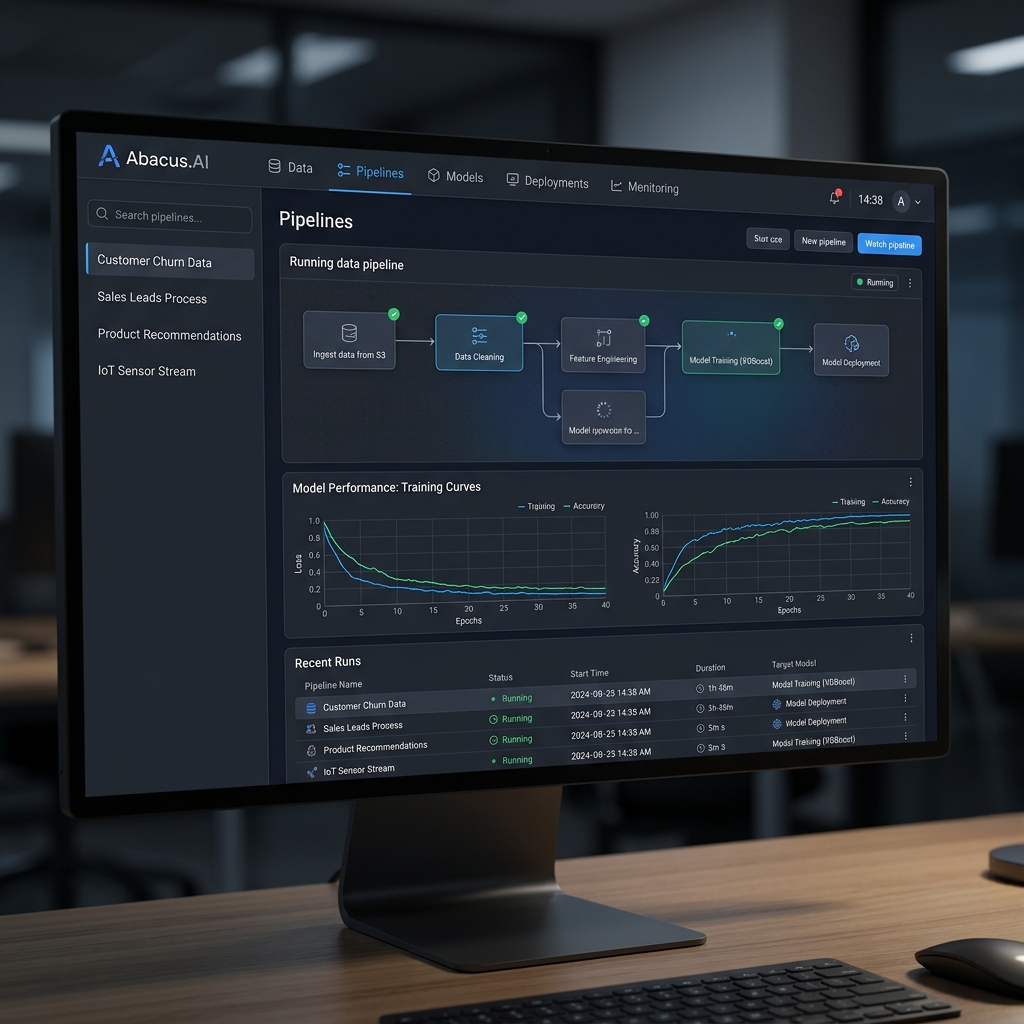
Abacus.AI is no longer just an interesting AI brand to watch. For many teams, it is becoming a practical workspace for applied AI, internal assistants, agents, and workflow automation.
What makes the platform stand out is its attempt to bring multiple high-value capabilities into one environment instead of forcing teams to piece together a dozen separate tools.
If you are comparing AI platforms for productivity, internal knowledge access, or real workflow execution, this review will help you decide whether Abacus.AI fits your needs.
What is Abacus.AI?
Abacus.AI is an applied AI platform built for professionals, teams, and enterprises that want more than a standalone chatbot. Instead of offering one narrow feature, it combines conversational AI, agentic automation, document handling, model access, and business-focused AI systems in a single ecosystem.
In practical terms, that means you can use Abacus.AI to chat with advanced models, connect knowledge sources, create custom assistants, automate work with agents, and build AI-powered business workflows without starting from scratch each time.
For organizations that want AI to move beyond experimentation, that positioning matters. The platform is designed around getting useful work done, not just generating text.
Why teams are paying attention to Abacus.AI
The biggest appeal of Abacus.AI is consolidation. Many teams already use separate products for chat, research, documents, automation, connectors, image generation, and coding support. That fragmentation adds cost, friction, and context switching.
Abacus.AI aims to reduce that sprawl by giving users one AI environment with access to multiple models and capabilities. That can be especially valuable for lean startups, operations teams, consultants, and internal innovation teams that want a wider AI stack without a complicated rollout.
Another reason the platform gets attention is that it speaks to both ends of the market. Small teams can use it to speed up day-to-day work, while larger organizations can approach it as a platform for applied AI use cases such as forecasting, personalization, intelligent workflows, internal search, and business process automation.
| What stands out | Why it matters |
|---|---|
| Unified AI workspace | Reduces tool switching and gives users one place to work with chat, automation, and AI-powered tasks. |
| Agent-driven workflow support | Moves AI from conversation into actual execution and repeatable task handling. |
| Business-ready use cases | Useful for teams that want outcomes like research, operations support, content workflows, or analysis. |
| Scalable positioning | Can be relevant for individuals, small teams, and enterprise programs. |
Core capabilities you can expect
1. A multi-model assistant experience
One of the most attractive parts of the platform is access to multiple leading model experiences in one place. That matters because modern AI work is rarely one-size-fits-all. Some tasks need speed, some need reasoning depth, some need coding support, and some need multimodal outputs.
A platform that lets teams adapt model choice to the task can improve both efficiency and output quality.
2. AI agents and workflow execution
Abacus.AI is particularly compelling when you want AI to do more than answer questions. Agent-based execution can help with recurring research, content operations, task orchestration, simple business processes, and knowledge-heavy internal work.
This is where the platform starts to move from assistant to operator. That shift can save time for teams that repeat the same workflows every week.
3. Connectors and knowledge access
A good AI tool becomes far more useful when it can work with your actual documents, apps, and company information. Abacus.AI emphasizes connected work, which helps teams use AI against real context instead of generic prompts alone.
For knowledge work, this often creates the difference between a clever demo and a tool people actually keep using.
4. Support for creation and analysis
Abacus.AI is also positioned for multimodal and knowledge-heavy output: document handling, code assistance, research tasks, image generation, and more. For content teams, analysts, operators, and power users, that breadth can turn the platform into a serious productivity layer rather than a novelty.
Best use cases for Abacus.AI
The platform is strongest when you have recurring high-value knowledge work that can be accelerated, standardized, or partially automated. It is less about replacing every employee and more about increasing throughput and reducing manual overhead.
- Internal research and synthesis: great for teams that summarize documents, compare sources, or prepare decision-ready outputs.
- Content operations: useful for outlines, rewrites, idea expansion, structured drafts, and workflow support around editorial tasks.
- Customer or team knowledge assistants: helpful when users need one place to ask questions across approved information sources.
- Business process automation: effective for repetitive operational tasks that follow clear rules and inputs.
- Technical experimentation: useful for teams exploring AI apps, prototypes, or internal tools without a heavy engineering lift.
If your work repeatedly involves searching, synthesizing, formatting, routing, or drafting, Abacus.AI is the kind of platform that can create meaningful leverage.
Who should use Abacus.AI?
Abacus.AI is a strong fit for professionals and teams that want breadth, flexibility, and a path toward practical AI operations.
| User type | Why it fits |
|---|---|
| Consultants and agencies | They often need fast research, content support, workflow speed, and client-ready outputs. |
| Operations teams | They benefit from process support, internal copilots, and automation around recurring tasks. |
| Startups | They can get multi-capability AI value without stitching together a large tool stack. |
| Innovation and AI teams | They can test applied AI use cases with a platform designed for business execution. |
| Knowledge workers | They gain a practical assistant for drafting, analysis, planning, and structured output. |
If your main need is a simple chat app with no automation ambitions, Abacus.AI may be more platform than you need. But if you want AI that can evolve with your workflows, it is much more compelling.
How to get started without overwhelm
The smartest way to begin with Abacus.AI is not to automate everything at once. Start with one recurring workflow that already costs time. Good examples include weekly research summaries, internal Q&A over shared knowledge, recurring content preparation, or structured document analysis.
- Pick one repeatable use case with a clear input and output.
- Define what a good result looks like before you involve the tool.
- Test prompts and workflows on real internal examples, not toy tasks.
- Document a lightweight team playbook so usage becomes repeatable.
- Expand only after you can measure time saved or quality improved.
This approach helps teams avoid random experimentation and build real adoption around visible wins.
Final verdict
Abacus.AI is best understood as a practical AI work platform rather than a simple chat product. Its real value comes from combining model access, assistants, agents, and workflow support inside one environment.
For teams that want AI to be useful across research, drafting, knowledge access, and operational workflows, Abacus.AI offers a stronger long-term proposition than tools that only handle conversation. It is especially worth a serious look if your team wants to move from scattered AI experiments to structured, repeatable execution.
If you are evaluating AI tools for real business use, Abacus.AI deserves a place on the shortlist.
Frequently asked questions
What is Abacus.AI used for?
Abacus.AI is used for AI-powered chat, agents, workflow automation, knowledge access, analysis, and business-oriented applied AI tasks.
Is Abacus.AI only for enterprises?
No. It can be useful for individuals and small teams, but it also offers capabilities that make sense for larger organizations.
What makes Abacus.AI different from a basic chatbot?
It is designed to go beyond conversation by supporting connected knowledge, agents, automation, and wider applied AI workflows.
Who gets the most value from Abacus.AI?
Teams with recurring knowledge work, analysis, drafting, internal support, or process-heavy operations usually get the most value.
Image recommendation for Blogger: keep the official screenshot as the featured image and retain loading="lazy" on any additional images.